About MEKLIT
A local platform for integrated community action.
MEKLIT — Making Every Talent Shine to Enlighten Lives — is an Ethiopian multi-sectoral development organization improving household and community well-being by connecting health, livelihoods, food security, environmental health and locally available expertise.
Who we are
We start with households and communities.
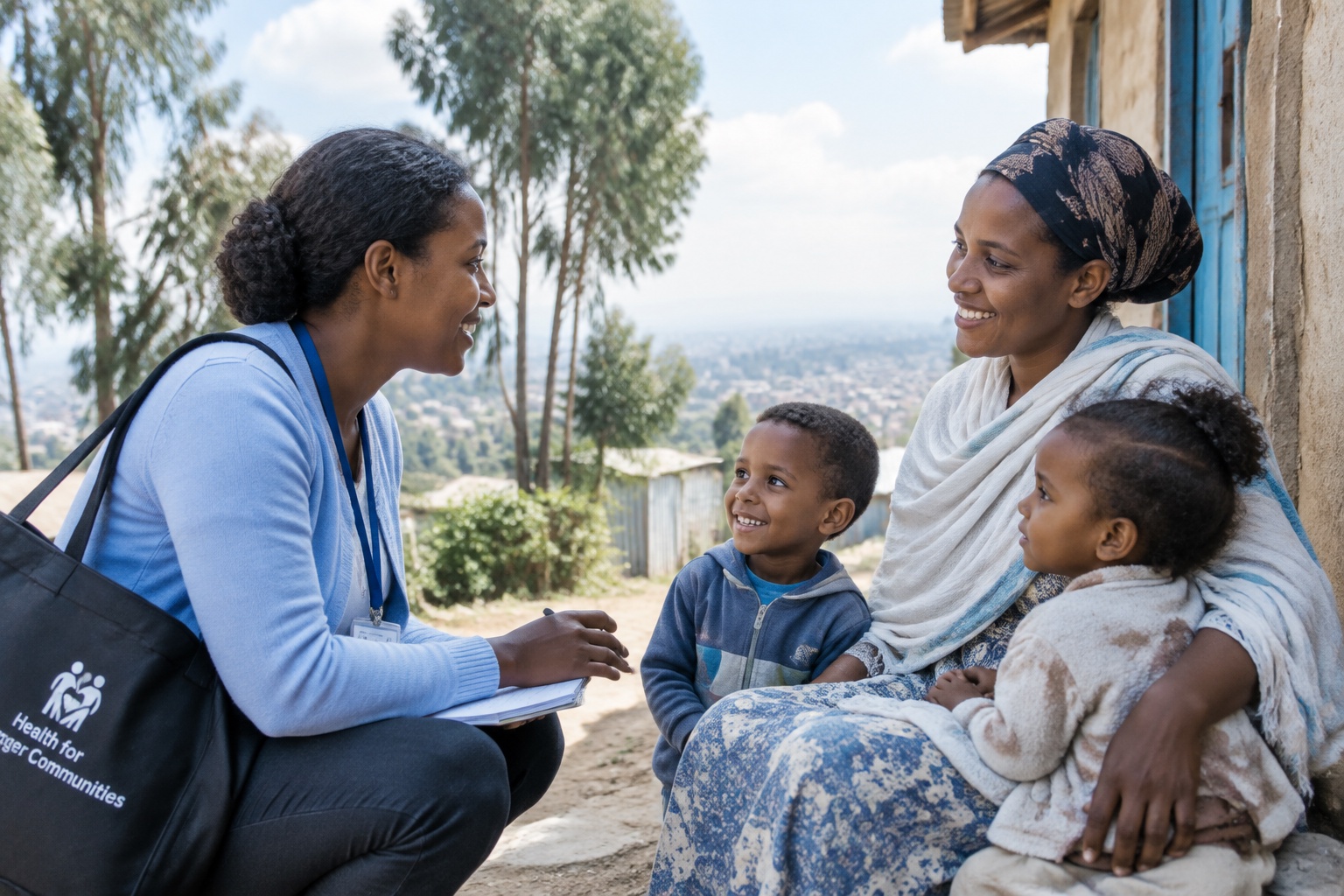
We identify the interconnected factors shaping well-being, then mobilize multidisciplinary expertise, institutional partnerships and locally available resources to develop practical, locally owned solutions.
Through participatory research, human-centred design, agile implementation and evidence-informed adaptation, MEKLIT connects services and sectors that are often planned and delivered separately.
Health and well-being provide the entry point; household and community conditions determine the intervention; multisectoral collaboration provides the solution.
Legal status
Officially licensed indigenous civil society organization
MEKLIT Multi-Sectoral Development Organization is registered with the Authority for Civil Society Organizations (ACSO) under Proclamation No. 1113/2019. Following registration, MEKLIT is moving from legal incorporation to full programmatic execution, with its office and administrative base in Addis Ababa.
Strategic orientation
Anchored on multi-sectoral convergence:
- Health
- Agriculture
- Education
- Finance
- Digital innovation
Executive lead
- NF
Dr. Netsanet Fetene
MD, MPH, PhD
Founder & General Manager
- WT
Mr. Wondwossen Tesfaw
Agronomist · Master in Urban Development
Founder & Executive Director
MEKLIT is governed by a Board of Directors responsible for oversight, its committees and endorsing the multi-year strategic plan.
Why an integrated model
The gap is coordination—not simply a shortage of projects.
Sector-by-sector responses
Services may address individual needs while households navigate multiple providers, eligibility rules and referral pathways.
Weak connections
Hand-offs between health, livelihoods, food systems, education and environment can be unclear or incomplete.
A household-centred bridge
MEKLIT connects priorities, expertise and resources around the household—while respecting specialist mandates.
MEKLIT’s role — digital technology
Sector interoperability: shared data, timely decisions.
MEKLIT uses digital tools to make sectors talk to one another. Instead of each partner keeping separate records, we connect health, livelihoods, food, education and environment information around the same household, so everyone involved sees the same picture and can act on it while it still matters.
Connect sectors
Common household references and shared indicators link service systems that usually run apart.
Share data
Agreed, consented information moves between partners rather than being collected twice.
Decide in time
Current information supports referral, follow-up and escalation at the moment it counts.
MEKLIT’s role — responsible AI & health workforce capacity
Building health professionals who can evaluate AI—and use it responsibly.
MEKLIT will build the capacity of health professionals to evaluate AI and use it responsibly for productivity and for community-level clinical decisions: writing and refining prompts, checking outputs for bias, contributing the human feedback that improves clinical models, and stress-testing tools against local languages, cases and constraints. Alongside that, MEKLIT aims to open routes for Ethiopian clinicians into paid AI clinical-evaluation work in the global market.
- Human in the loop
- Consent before use
- No automated decisions about people
- Bias tested before deployment
- Stress-tested on local cases
- Fair pay for evaluation work
Prompt engineering for health work
Health professionals learn to write, refine and check prompts that save time on documentation, translation, summarising and preparation—while knowing where a tool’s answer stops being trustworthy.
Bias detection and stress testing
Before a tool is used with people, it is tested for bias and pushed to failure on local languages, atypical cases, missing data and low-resource settings, so weaknesses surface in testing rather than in a household.
Human feedback that improves models
Clinicians and health extension workers contribute structured ratings and corrections on AI output, so models used in Ethiopian contexts are shaped by people who actually work in them—and AI at community level stays decision support a qualified professional confirms.
Paid clinical AI evaluation as a career route
The same skills—reviewing clinical AI output for safety, accuracy and bias—open entry to the global market for AI clinical evaluation, giving clinicians and health extension workers paid remote work and MEKLIT a way to grow expertise at home.
MEKLIT’s role — climate intelligence
Model what the season will bring: weather, disease and livelihood risk.
MEKLIT connects public weather and climate information with health, crop, livestock and nutrition data, and uses modeling and forecasting to look ahead rather than only report what has already happened. The value is the decision a forecast triggers: which households are likely to need support, which illnesses may rise, which harvests are at risk—and which partner should act first.
- WatchCollect weather, climate, health and farm signals
- ModelLook for patterns and leading indicators
- AlertShare what is likely to happen, and where
- ActRefer, prepare and follow up with households
Meteorological outlook
Rainfall, temperature and extreme-weather forecasts are read down to the communities we work with, not left as national averages.
Disease-pattern forecasting
Climate and health signals are examined together so likely rises in waterborne, vector-borne and respiratory illness can be anticipated early.
Harvest and nutrition risk
Crop, livestock and market indicators show where food and income are likely to come under strain before a crisis is declared.
One signal, several sectors
The same seasonal outlook feeds health, livelihood, food-security and environment planning, so partners work from one shared picture.
MEKLIT does not generate meteorological forecasts itself. It works from public forecast services, open climate data and field reporting, with technical partners, and translates them into what households and partners should do next.
MEKLIT complements public systems and specialist organizations; it does not replace them. Our role is to convene, coordinate, test and strengthen locally grounded solutions with capable technical and implementation partners.
The rationale for multisectoral action
Health is the entry point—not the boundary.
Health & well-being
A practical starting point for identifying household needs, risks and service-access barriers.
Household context
Food, income, care responsibilities, education, housing and environment shape what is possible.
Coordinated action
Connect the right expertise and resources to locally prioritized solutions.
Integration means a shared assessment, agreed priorities, clear partner responsibilities, coordinated follow-up and measurement of combined results.
Our name
MEKLIT — “Make it lit.”
Like the candle in our logo, MEKLIT believes every person carries a light. Our name stands for Making Every Talent Shine to Enlighten Lives: discover your talents, develop new skills, understand real community needs and turn your talent into solutions that build healthier, stronger communities.
Your Meklit. A better tomorrow for others.
What guides us
Cross-cutting commitments
- Inclusion
- Participatory research
- Human-centred design
- Partnerships
- Safeguarding
- Monitoring, evaluation, accountability & learning (MEAL)
- Gender and social inclusion
- Community ownership
Partner with MEKLIT to turn local priorities into measurable, connected solutions.
Co-design · Co-finance · Co-learn · Co-scale. The next step is a joint scoping conversation on one place and one or two clearly defined household problems.